Industry Insights
September 21, 2026
Progressive Lending & Earned Trust
.svg)
.svg)


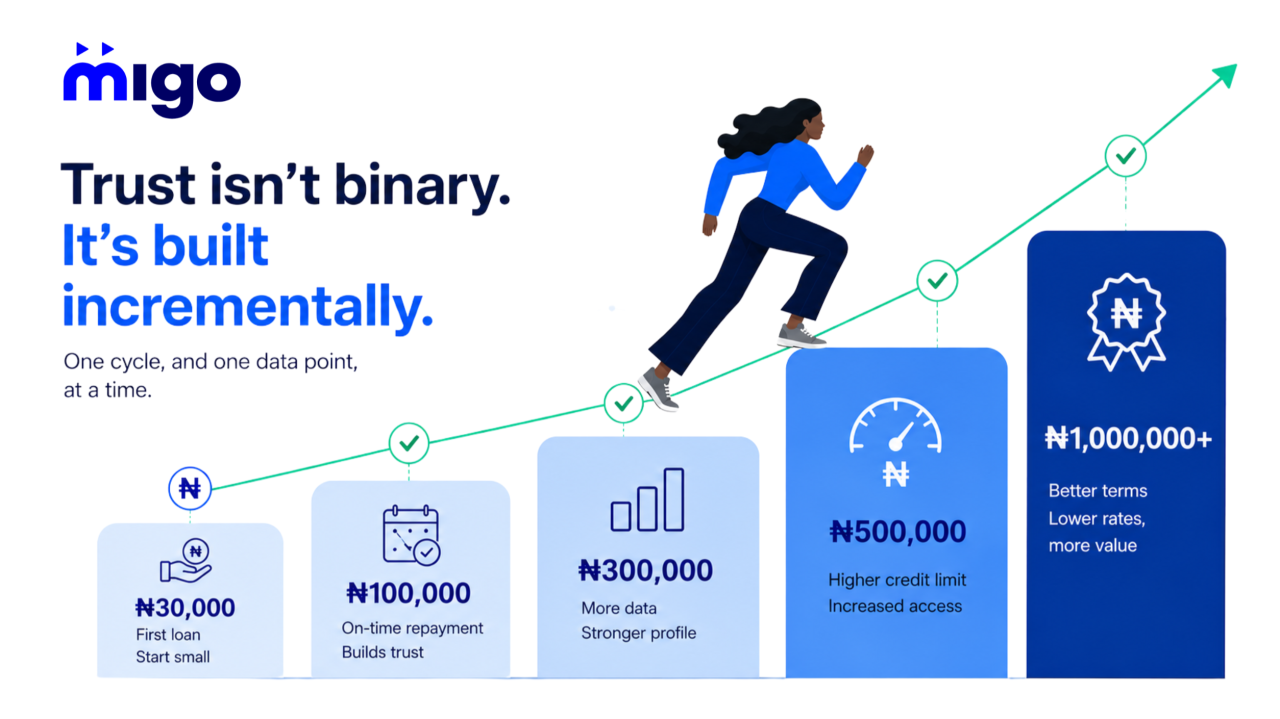
Most traditional credit systems treat risk like a binary switch: you either qualify for a large loan, or you don’t qualify at all. When you're building financial access in emerging markets, that model is fundamentally broken. Here’s what designing credit decisioning systems at Migo has taught us: trust isn’t binary. It’s built incrementally.
When a new borrower comes to our platform, they often lack a deep, formal credit history. Relying solely on static scorecards means we’d either reject people who deserve a chance, or give borrowers limits that expose them to unnecessary risk.
Instead, we take a progressive approach to data and lending. We start small. The first loan isn't about maximum volume; it’s about establishing a baseline. Every time a borrower repays on time, whether it’s a small balance to restock a shop or cover an urgent household bill, our machine learning models pick up on those signals.
With every successful cycle:
- Risk models recalibrate using real, dynamic repayment behaviour rather than rigid external assumptions.
- Credit limits adjust upward organically.
- Pricing and terms become more favourable to reflect the established relationship.
The data science behind this requires continuous retraining and robust ML pipelines, but the real-world outcome is simple: we aren't just predicting risk, we are helping users systematically build a credit profile from scratch.
In data science, it’s easy to focus solely on optimising for pure model accuracy. But for lending to underserved populations, the best models are the ones that create a clear, earned path toward financial growth for the borrower.
Building trust takes time. One cycle, and one data point, at a time.
.svg)
.png)
Financial Literacy
Salary Advance Loans in Nigeria | Fast Payday Loan by Migo
Need a salary advance loan in Nigeria? Migo offers fast, low-interest payday loans with no paperwork, no collateral, and no stress. Apply online today.

